Step 1. Introduce

SpoonTime Start Kit

The proven way to help prevent food allergies.

SpoonTime Start Kit is a science-based program that helps support immune development by introducing food allergens early. Instead of guessing, introduce them step by step, in safe doses.

6 months+ · 10 allergens · 4.89 / 5 from 2,000 reviews

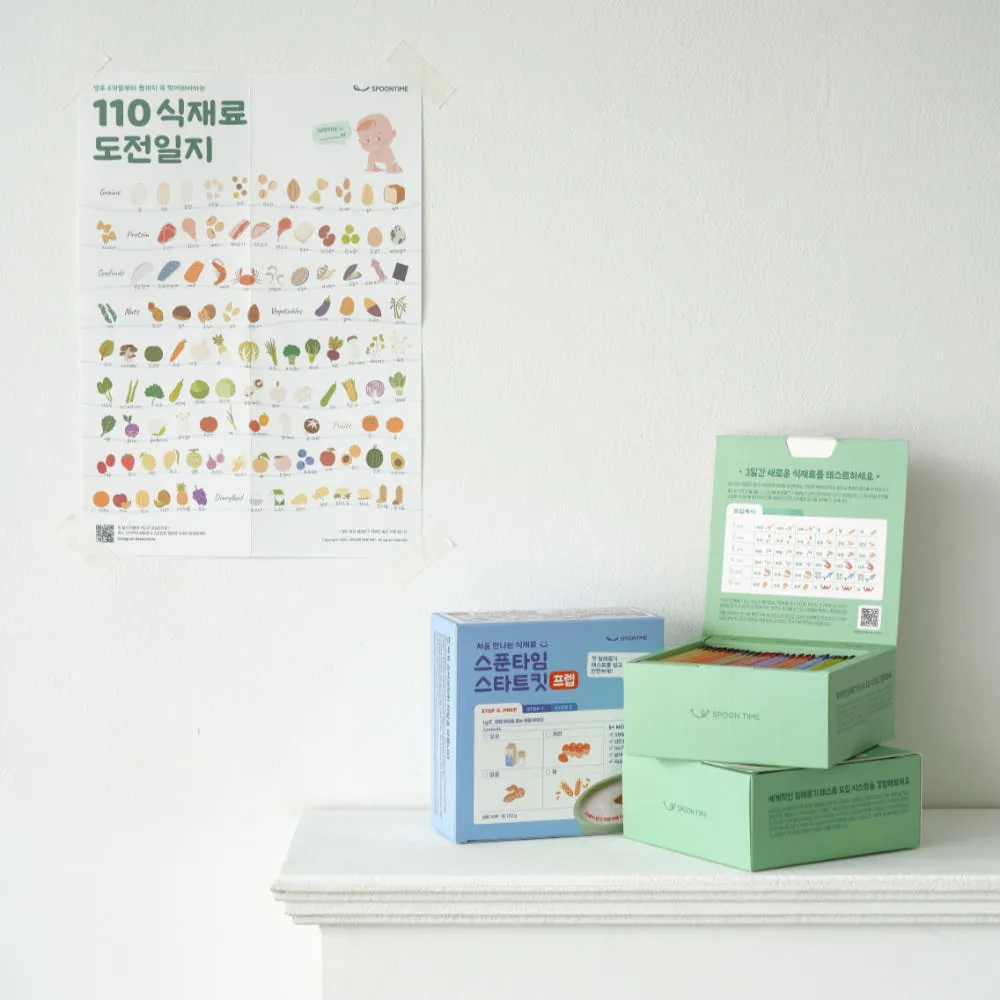
SpoonTime Start Kit product box
*What is allergen introduction?

The current weaning approach recommended by the WHO and pediatric societies. Introducing allergens early helps lower the risk of developing food allergies and supports healthy immune development.

Why Now

Introduce early, offer often — there is no reason to wait

Pediatricians, allergy specialists, and recent research all recommend introducing allergenic foods from around 6 months. Waiting may feel safer, but it offers no medical benefit and is linked to higher rates of food allergy.

When allergenic foods are offered safely and consistently until they become a regular part of the diet, babies can grow up healthier.

1 in 13

Babies who experience a food allergy (milk and egg are the most common)

40%

Share of babies with one food allergy who go on to react to another food

6–24 months

The immune window while the gut is still developing

Lineup

Two lineups, matched to each weaning stage

SpoonTime Start Kit comes in two lineups, matched to your baby's weaning stage and how each food is introduced. Start with PREP at the thin-porridge stage, then expand to the 10-allergen kit at the porridge and topping stage.

STEP 0● From the thin-porridge stage · boil before serving

SpoonTime Start Kit PREP (Step 0)

Milk and egg included — boiled into porridge, safely
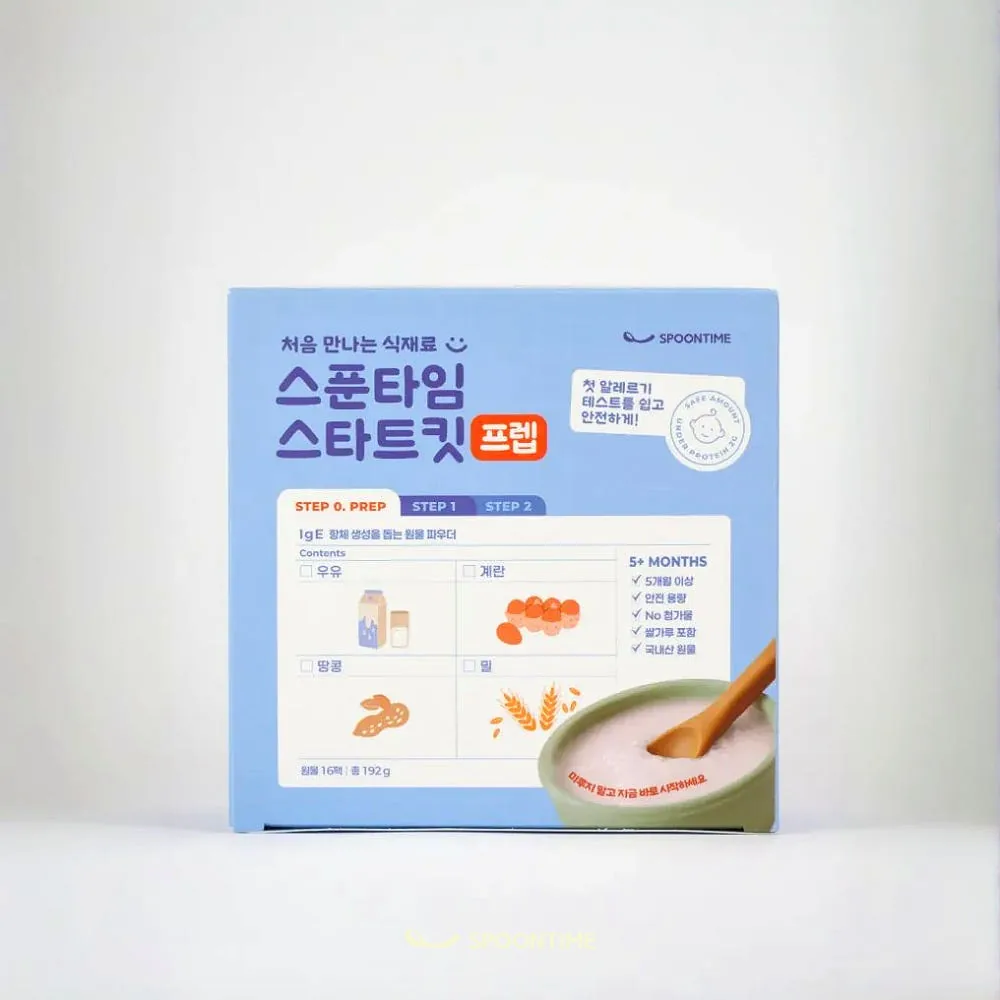
SpoonTime Start Kit PREP package
Weaning stage
From the thin-porridge stage
Allergens
Peanut · Wheat · Egg · Milk (4)
Composition
Contains rice flour — cook as thin porridge or porridge
How to use
Boil before serving (required)
Recommended for

Parents who want to start from the thin-porridge stage, or to introduce milk and egg — more common triggers — more cautiously by boiling them.

Shop PREP (4 foods) →

Adds milk and egg, which the 10-allergen kit does not cover, from the earliest stage
STEP 1● Porridge / topping stage · 10 allergens

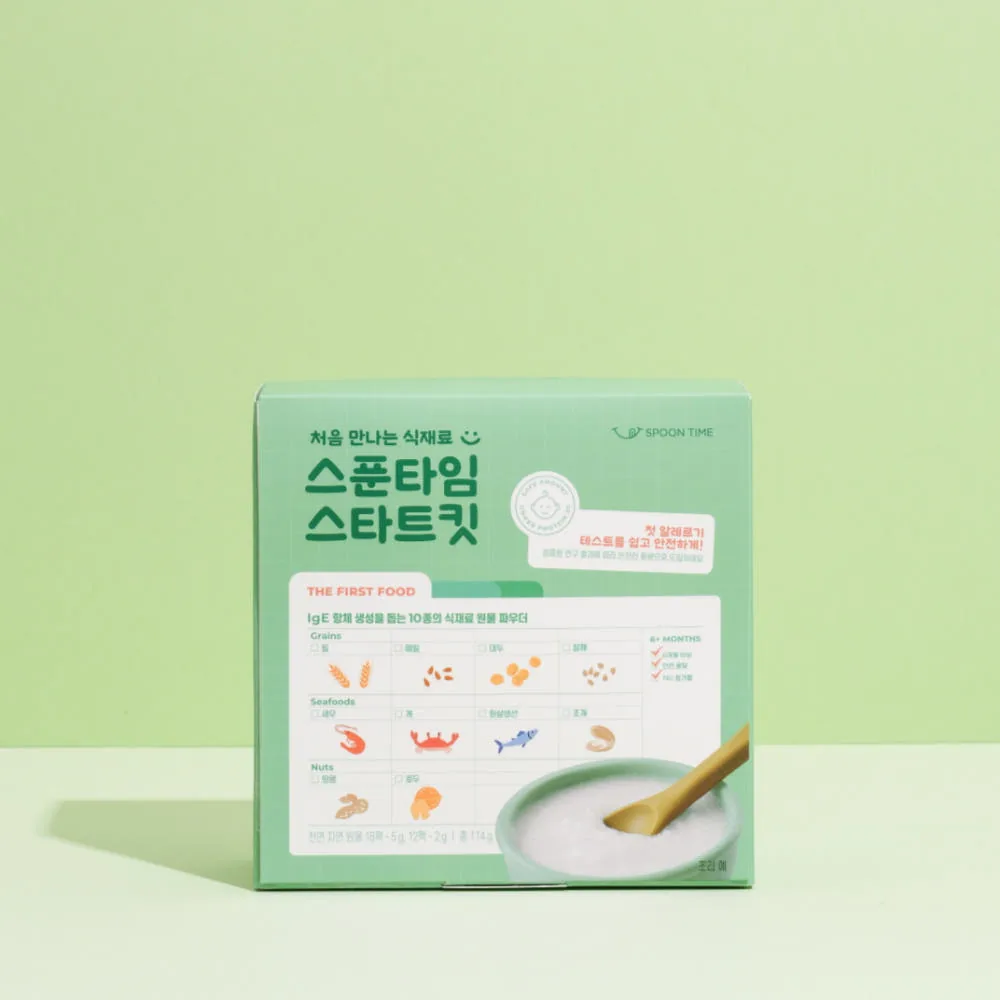
SpoonTime Start Kit (Step 1)

Korea's first kit covering 10 major allergens

SpoonTime Start Kit box with 10 allergens
Weaning stage
From the porridge stage
Allergens
Peanut · Wheat · Buckwheat · Soy · Sesame · Crab · Shrimp · White fish · Shellfish · Walnut (10)
Composition
No rice flour — single-origin powders
How to use
Sprinkle onto porridge or purée, no cooking needed
Recommended for

Parents ready for the porridge stage who want to introduce the major allergens broadly and systematically, following standard guidelines.

Shop the Start Kit (10 foods) →

Milk and egg are covered separately in PREP (Step 0)

The two lineups complement each other rather than replace each other. At the thin-porridge stage, use PREP · Step 0 to introduce 4 foods including milk and egg by boiling them, then move on to Start Kit 10 · Step 1 at the porridge stage to broaden coverage of the major allergens.

Compare the lineups at a glance

Weaning stage
STEP 0From the thin-porridge stage
STEP 1From the porridge stage
Allergens included
STEP 0Peanut, wheat, egg, milk
STEP 1Peanut, wheat, buckwheat, soy, sesame, crab, shrimp, white fish, shellfish, walnut
Rice flour
STEP 0Included (add water and boil)
STEP 1None (single-origin powder)
How to use
STEP 0Boil before serving (required)
STEP 1Sprinkle on as-is, no cooking
Key value
STEP 0Includes milk and egg, the most common allergy triggers
STEP 1Broad introduction of 10 major allergens
Product Spec

What's inside

Compare what each lineup includes

STEP 0SpoonTime Start Kit PREP · 4 foods
Total weight
192 g
Sachets
14 g × 4 + 12 g × 8 + 10 g × 4 (16 sachets)
Ingredients
Peanut · Wheat · Egg · Milk (4)
Shelf life
365 days from production
No additives
No preservatives, no artificial flavors, no added sugar
STEP 1SpoonTime Start Kit · 10 foods
Total weight
114 g
Sachets
5 g × 18 + 2 g × 12 (30 sachets)
Ingredients
Wheat · Buckwheat · Soy · Sesame · Shrimp · Crab · White fish · Shellfish · Peanut · Walnut (10)
Shelf life
365 days from production
No additives
No preservatives, no artificial flavors, no added sugar
Science

Not a guess.
A method proven by research.

Every step of the SpoonTime Start Kit is built on international allergy research and clinical guidelines. About 70% of a baby's immune system develops in the gut — SpoonTime introduces allergens early, during that window, to support a healthy immune response.

L.E.A.P. Study (2015)

Peanut allergy reduced by 81%

In a study following 640 infants aged 4–11 months to age 5, those who introduced peanut early had a significantly lower rate of peanut allergy. First exposure at 4 months, 4 years of follow-up, about 6 g of peanut protein per week.

NEJM, 2015
E.A.T. Study

Lower allergy rates with early introduction of 6 key foods

When 1,303 infants were introduced to peanut, egg, milk, sesame, fish, and wheat from 3 months, the rate of certain food allergies was significantly reduced. First exposure at 3 months, 3 months of introduction, about 4 g of protein per week.

NEJM, 2016
P.E.T.I.T. Study (2017)

Egg allergy can also be prevented in high-risk infants

Infants aged 4–5 months with eczema, a high-risk group, were introduced to egg early. Starting with small amounts and gradually increasing was shown to help lower the risk of food allergy. First exposure at 4 months, 6 months of introduction, 50–250 mg of egg protein per week.

The Lancet, 2017
USDA 2020 Dietary Guidelines

Don't delay introduction.

The U.S. Dietary Guidelines clearly recommend not delaying the introduction of allergenic foods. The Addendum Peanut Allergy Prevention Guidelines recommend about 2 g of peanut protein per serving, offered regularly.

USDA, 2020
Patent

A composition design backed by a registered patent

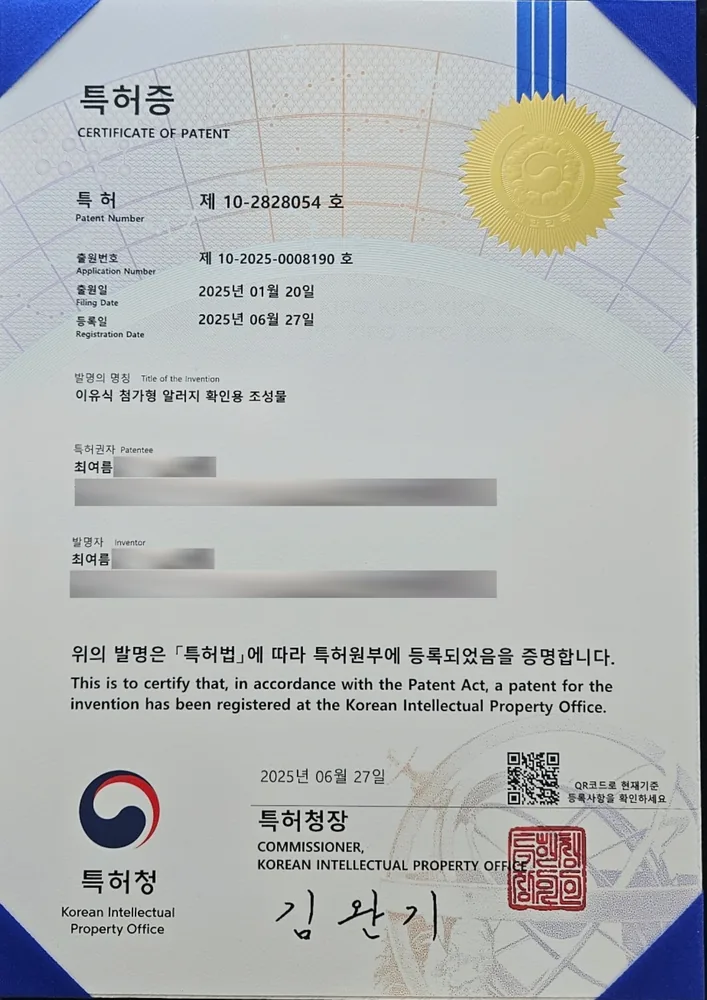
The allergen-introduction composition at the core of the SpoonTime Start Kit is registered with the Korean Intellectual Property Office.

Patent certificate for the weaning-food allergen introduction composition (No. 10-2828054)
Registered with KIPO

Allergen-introduction composition for weaning food

The composition design of the SpoonTime Start Kit — mixed into prepared weaning food to introduce allergenic ingredients step by step — is formally registered with the Korean Intellectual Property Office. It is research translated into product structure.

Title of invention
Allergen-introduction composition for weaning food
Patent number
No. 10-2828054
Filing date
Jan 20, 2025
Registration date
Jun 27, 2025
Authority
Korean Intellectual Property Office (KIPO)

This patent covers the composition (product structure) and is not a certification of allergy-prevention efficacy. We recommend introducing allergens alongside advice from your pediatrician.

Safety

Why it's safe

SpoonTime follows five principles for safe allergen introduction.

01

Earlier is safer.

Adverse reactions occur in under 1% of infants introduced before age 1. Across clinical data covering about 2,000 infants, most reported reactions were mild, and progression to a severe reaction was very rare.

02

Designed in minimum doses.

Each serving is set below the doses used in clinical studies — enough to help support antibody development while keeping the chance of an allergic reaction as low as possible. If hives or a rash appear, simply stop the food.

03

One ingredient at a time.

Allergens are introduced one by one, never all at once, so if a reaction occurs the food responsible can be identified right away. This matches guidance from the Korea Disease Control and Prevention Agency.

04

Aligned with global pediatric guidelines.

Allergenic foods are recommended from 4–6 months of age. Medical guidelines worldwide were revised from 2017 onward, and SpoonTime follows the scientific evidence and clinical guidance closely.

05

Co-designed with pediatricians.

Professor Inhyuk Ryoo (pediatric gastroenterology and nutrition) and pediatrician Yeonwoo Choi took part from the earliest design stage, so the product follows medical guidance and uses the same doses validated in clinical studies.

Tested

Verified safety

The SpoonTime Start Kit has completed the following safety tests.

E. coli and heavy-metal testing — completed

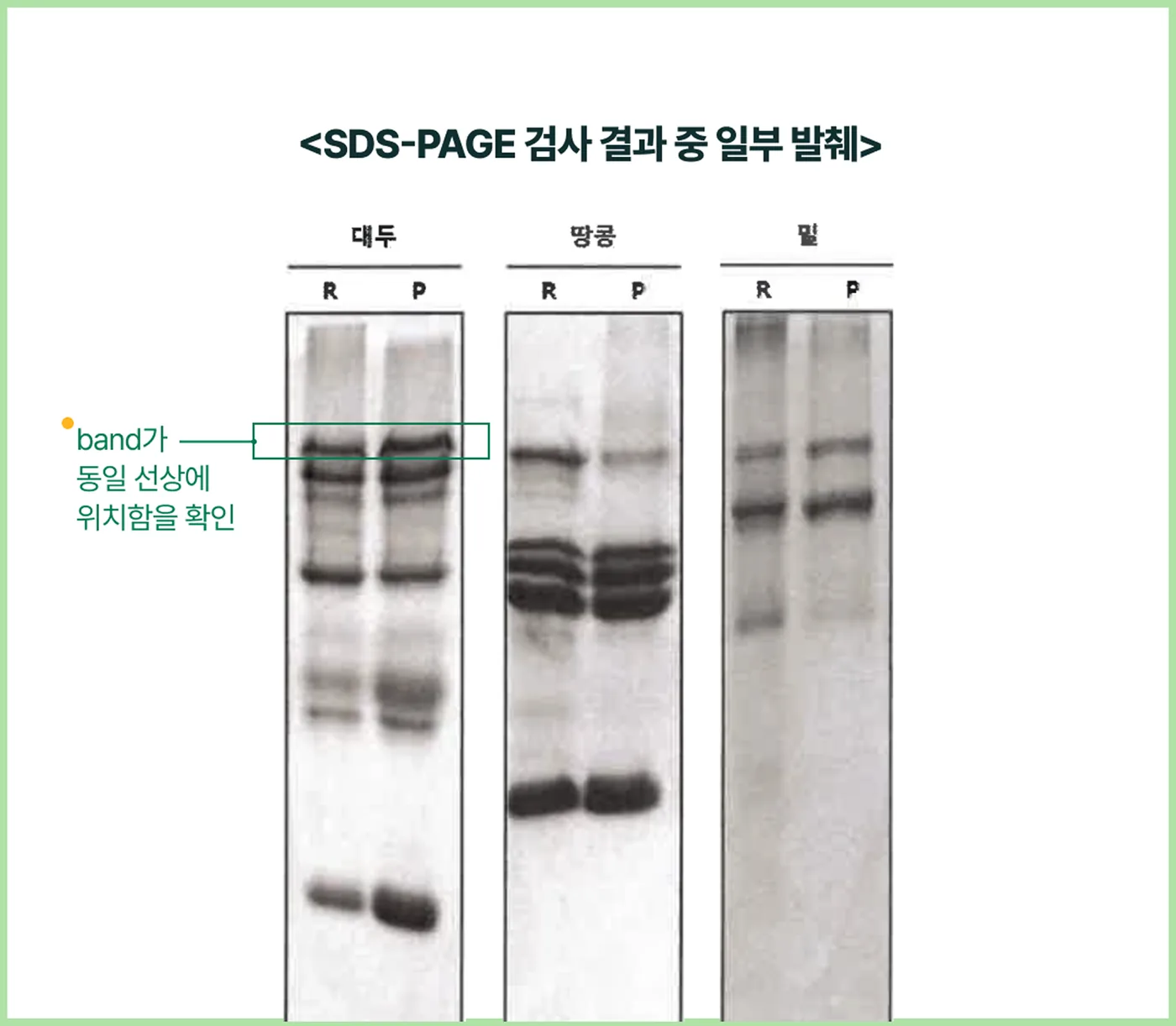
Protein-integrity testing (SDS-PAGE) — allergen retention verified

All ingredients are heat-treated and roasted to minimize allergic reactions

Excerpt from SDS-PAGE results — soy, peanut, and wheat protein bands aligned at the same level
Excerpt from SDS-PAGE results — protein bands before and after roasting (R/P) align at the same level, confirming that allergenic proteins are retained
How to use

How to use the Start Kit

Start on a day when your baby feels well, at the first feed of the morning (around 10 a.m.).

  1. 01

    Start with a small amount

    Mix about half a sachet of the 10-allergen kit into porridge or oatmeal; for PREP, add water, boil, and serve in portions. If there's no reaction, gradually increase to the full sachet.

  2. 02

    Offer it in the morning

    Most allergic reactions appear within two hours of eating, so the first meal of the day (around 10 a.m.) is recommended. Stay with your baby and observe for two hours afterward.

  3. 03

    One ingredient at a time

    Introduce one new food at a time over three days, so you know exactly which food caused any reaction.

  4. 04

    Offer it regularly

    If introduction goes well, include the food at least twice a week to help maintain the immune response. Step-by-step recipes using the Start Kit are available in the SpoonTime app.

  5. 05

    Minimize choking risk

    Always serve nuts finely ground. Avoid whole nuts or large pieces until age 6.

Response Guide

How to watch for an allergic reaction

Observe

Mild symptoms

  • · Mild skin rash
  • · Localized hives
  • · Itching
  • · Runny or stuffy nose
  • · Watery or itchy eyes

A fever is not part of an allergic reaction. If one of these appears, stop the food and see a pediatrician. If two or more appear at once, treat it as a severe reaction and seek emergency care immediately.

Emergency

Severe symptoms

  • · Swelling of the lips, face, tongue, or throat
  • · Hives over the whole body
  • · Difficulty breathing or repeated coughing
  • · Repeated vomiting
  • · Paleness or bluish skin
  • · A drop in blood pressure
Call 119 (emergency services in Korea; call your local emergency number if outside Korea) and go to the ER immediately. Epinephrine may be required.
FAQ

Frequently asked questions

The questions parents ask most often before starting the Start Kit.

  • A parent's shellfish allergy does not mean your baby will have one too.

    A stronger family history does raise the genetic likelihood of allergy, but whether your baby actually reacts cannot be known until the food is introduced.

    Allergy is an antibody response to an antigen rather than something fixed at birth, so when and how a food is introduced can change the outcome. In most cases there is no need to delay.

    If you would like a clearer answer, a consultation with a pediatric allergy specialist at a university hospital is a good option.

  • If it isn't clear enough to warrant a clinic visit, first record the reaction, how long it lasted, and what your baby ate, and take a photo of the affected area. If the same symptom appears when you reintroduce the same food after 2–3 weeks, an allergy is likely and it's time to see a doctor.

    We don't recommend deciding on your own that a food is an allergen and removing it from the diet — that can lead to nutritional gaps.

    Also note that a reaction to peanut does not mean a reaction to walnut, and a reaction to one crustacean does not mean a reaction to all seafood. If you're unsure about introducing a food, speak with your pediatrician first.

  • Current medical guidance points to early introduction as the most reliable way to help prevent food allergy. The longer introduction is delayed, the stronger the antibody response can become, so the body is more likely to treat the food as an antigen rather than as food. Introducing small amounts early helps the immune system learn from the food, and that is today's standard guidance.

    That said, if your doctor has examined your baby and advised delaying introduction based on their individual condition, follow that advice first — an individual clinical assessment takes precedence over general guidance.

  • Babies with severe eczema are considered high risk, but whether they are allergic to a specific food cannot be known until it is introduced. Rather than postponing out of worry, it's important to introduce foods one at a time, slowly, while watching carefully for reactions. Simply delaying may in fact raise the likelihood of developing an allergy.

    With severe eczema, a skin rash alone can be hard to read. If any of the following also appear, a food allergy is possible — take a photo and see your doctor.

    • · Repeated vomiting after feeding
    • · Strong-smelling stool (a sour, yogurt-like smell)
    • · Blood or mucus in the stool
    • · Severe infant colic

    SpoonTime designs its products on medical evidence but does not examine your baby directly, so if eczema is severe, we recommend consulting a pediatrician before starting the Start Kit.

Don't leave it to chance.
Try SpoonTime.

Korea's first allergen-introduction kit, co-designed by two pediatricians and a registered dietitian.
Step-by-step recipes using Start Kit ingredients, introduction logs, and reaction checks — all in the SpoonTime app.